From Sustainability as a 6G Design Principle to 3GPP Priorities
The IMT-2030 vision positions sustainability as a key design principle for 6G, centered on improving energy efficiency, lowering lifecycle environmental impacts, and advancing circular economy practices.
Building on the energy-efficiency focus of 5G, 6G provides an opportunity to broaden sustainability into a core design principle, spanning network architecture, deployment, operation, lifecycle impact, and broader environmental and societal outcomes. The Next G Alliance (NGA) Sustainable Development Working Group (SDWG) has helped advance this holistic approach of looking beyond traditional network performance metrics and asking a broader question: how can 6G be designed to deliver environmental, societal, and economic value from the outset?
This question becomes increasingly important as the industry moves from defining sustainability and energy-efficiency objectives for 6G toward research, pre-standardization, and future standards development. The next challenge is to translate these objectives into research priorities that can realistically inform future 3GPP feature development.
This transition is essential. High-level sustainability goals will only influence future networks if they are connected to measurable technical capabilities, architectural choices, and standards-relevant priorities. This is where the SDWG’s current work can provide an important bridge between sustainability vision and practical standards alignment.
Addressing the Environmental Footprint While Maximizing the Positive Impact of 6G
A useful starting point is the distinction between 6G’s footprint and its handprint.
6G’s footprint refers to the environmental impact of the network itself. This includes energy consumption, embodied carbon, hardware lifecycle impacts, device efficiency, data center resource use, and end-of-life considerations such as reuse, repairability, and recycling. As traffic demand grows and new services emerge, the industry must continue to decouple network growth from energy and carbon growth. This requires sustainability to be considered across the full lifecycle of the system, from equipment design and manufacturing through deployment, operation, optimization, and decommissioning.
6G’s handprint refers to the positive sustainability impact that advanced connectivity can enable across other sectors. 6G capabilities such as pervasive sensing, ultra-reliable connectivity, edge computing, AI-enabled automation, and massive device support could help improve energy systems, transportation, manufacturing, agriculture, public safety, healthcare, and climate resilience. In this sense, 6G is not only a technology platform to be made more sustainable; it is also a potential enabler of sustainable transformation across the wider economy.
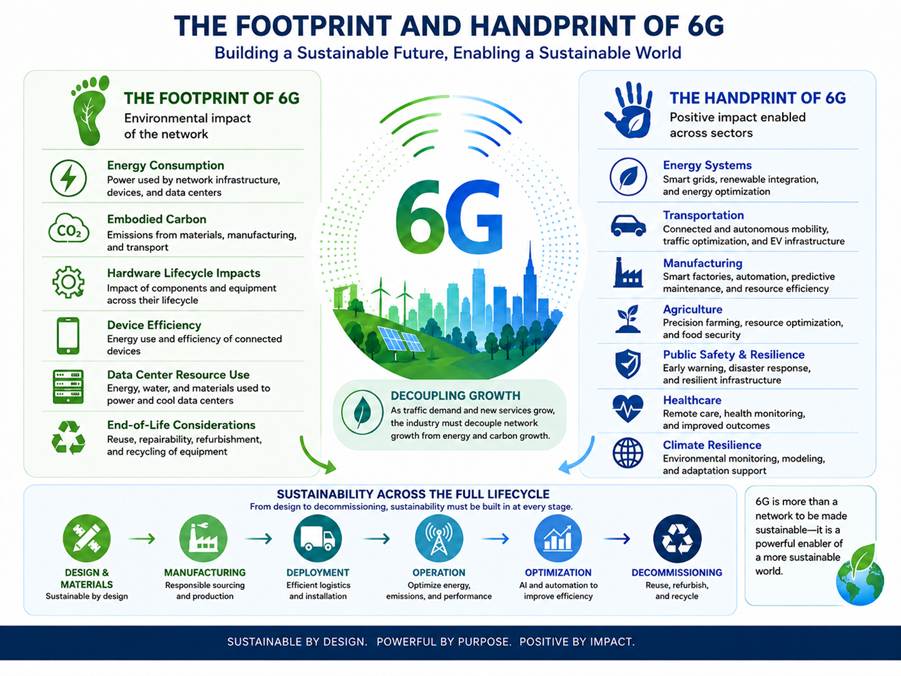
Source: Next G Alliance Sustainable Development Working Group; graphic developed with AI assistance.
Both dimensions matter and can be translated into research and standards priorities. For the footprint of 6G, this may include research into network energy saving, sleep-mode optimization, sustainable RAN design, device power reduction, core-network efficiency, sustainable data center integration, and carbon-aware network operations. For the 6G handprint, this may include identifying use cases where connectivity can measurably reduce emissions, improve resilience, or support more efficient use of resources in other industries.
Rise of AI and the Importance of Observability, Choice and Circular Economy
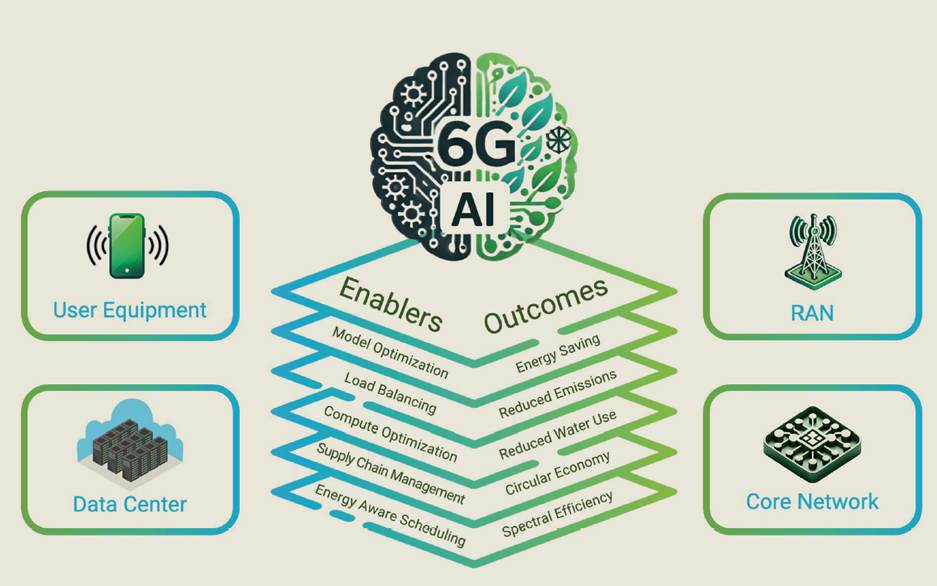
Artificial intelligence will play a central role in the 6G future by helping optimize network energy use, forecast demand, support dynamic resource allocation, enabling intelligent sleep cycles, and improving observability across network domains. At the same time, AI itself can increase compute, data, and energy demand. AI-native capabilities of the 6G Network can thus answer an important research question by improving sustainability outcomes without creating new sustainability burdens [1].
Measurement is another critical area. The industry cannot manage, optimize, or standardize what it cannot measure. Traditional performance indicators such as throughput, latency, reliability, and energy per bit remain important, but they are not sufficient on their own. 6G sustainability will require broader indicators that address energy and carbon efficiency, renewable energy use, lifecycle emissions, equipment circularity, water use, data center efficiency, and societal value.
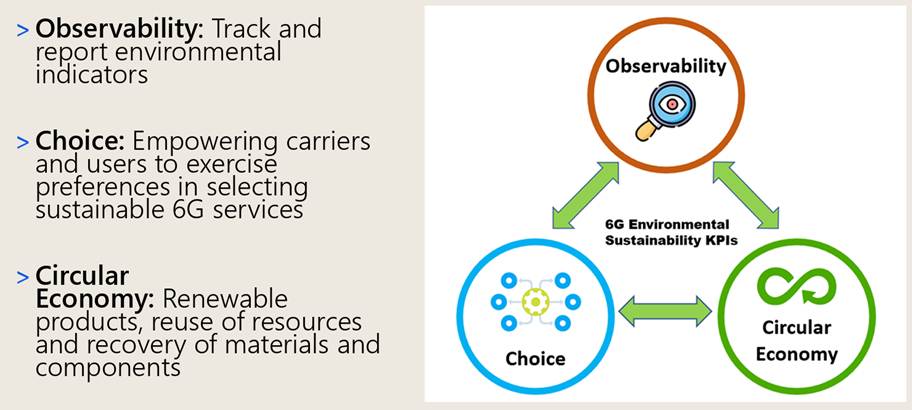
The Next G Alliance work on sustainability KPIs, and the Observability, Choice, and Circular Economy framework provides a strong foundation for this [2]. Observability enables better visibility into energy, carbon, and resource impacts. Choice allows network designers and operators to understand trade-offs between performance, cost, energy, and environmental impact. Circular Economy extends the focus beyond operational efficiency to include equipment longevity, reuse, repairability, and responsible end-of-life treatment.
The NGA’s key opportunity is to connect these concepts to the areas where research can inform standards. This does not mean every sustainability ambition will map to a specific standards feature. Rather, it means the industry should identify where technical maturity, measurable benefit, and standards relevance overlap.
For example, network energy saving techniques may provide a direct path toward standards discussions because they relate closely to RAN operation and feature development. AI-enabled observability may become important where data collection, automation, and optimization need common assumptions. Device energy efficiency may require coordination between network and device behavior. Carbon-aware operations may raise questions about how networks can adjust behavior based on energy availability or emissions intensity. Lifecycle and circularity metrics may influence how the industry evaluates sustainability beyond the operational phase of the network.
Role of the Sustainable Development Working Group
This is why the SDWG’s current work is timely. As 6G research accelerates and 3GPP priorities evolve, there is a need to understand which sustainability techniques have the greatest potential to translate into future standards activity. This includes approaches for network energy saving, AI-enabled optimization, sustainable RAN and device operation, core-network and data center efficiency, carbon-aware network behavior, and lifecycle-based sustainability measurement.
By examining these areas in greater detail, the SDWG can help identify where research is becoming technically mature, where measurable benefits can be demonstrated, and where further research, validation, or common industry understanding may be needed. In doing so, the group can help build the bridge between sustainability objectives and standards-relevant priorities, supporting the development of practical capabilities that can be evaluated, compared, and potentially reflected in future 6G standards.
The intended outcome is a clearer set of standards-relevant sustainability priorities, supported by measurable evidence, implementation considerations, and an understanding of the gaps that must be addressed before specific capabilities can be advanced for future 3GPP consideration.
Turning Ambition Into Action
The next phase of 6G research and standardization should focus on turning sustainability ambition into coordinated industry action. This is precisely the role the SDWG is well positioned to fulfill. By convening research organizations, standards bodies, and the North American telecom ecosystem, the SDWG will identify the sustainability priorities most ready for integration into future 3GPP feature development.
—–
[1] “Sustainable AI in Telecom: Promises and Challenges in 6G,” a Next G Alliance white paper.
[2] “Evolution of Sustainability Indicators for Next-Generation Radio Network Technologies,” a Next G Alliance white paper.
About the Authors